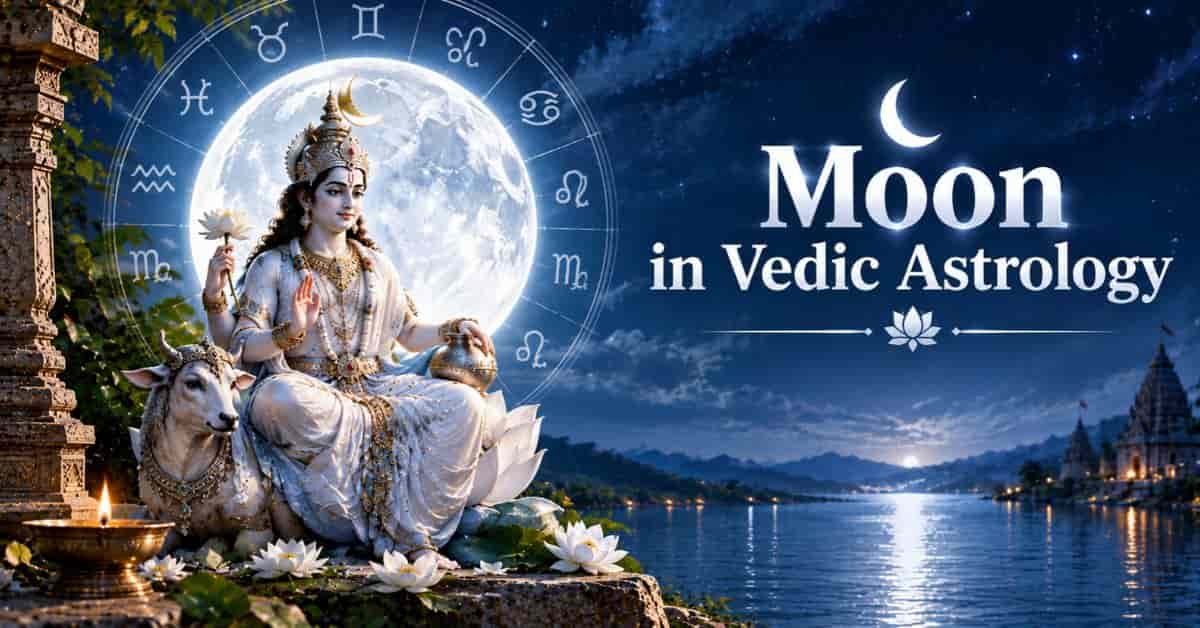
In Vedic astrology, the Moon (Chandra) represents the mind, emotions, receptivity, memory, nourishment and the mother. It is one of the most important Grahas in a birth chart because the Moon's sign, Nakshatra, house and condition are used in several important Jyotisha techniques.
Unlike the Sun, which is associated with conscious identity and vitality, the Moon describes how a person experiences, processes and responds to life within the traditional astrological framework.
In a Kundli, the Moon should never be judged from its sign alone. Its house, sign dignity, lunar phase, conjunctions, aspects, Nakshatra, lordship and Dasha must be considered together. Classical Jyotisha also gives the Moon an important role in determining the Janma Rashi (birth Moon sign) and the starting point of Vimshottari Dasha through the Moon's Nakshatra.
What Is the Moon in Vedic Astrology?
The Moon is known as Chandra, Soma or Indu in Sanskrit. In Jyotisha, Chandra is one of the nine Navagrahas.
The Moon is traditionally associated with Manas, commonly translated as the mind. It also signifies the mother, emotional responses, comfort, nourishment, memory and receptivity.
The Moon is particularly important because it moves rapidly through the zodiac. Its changing position and phases are traditionally associated with fluctuation, sensitivity and changing mental or emotional states.
However, these are astrological interpretations, not scientific claims about human psychology.
What Does the Moon Represent in Vedic Astrology?
The principal significations, or Karakatwa, of the Moon include:
| Moon Signification | Traditional Meaning |
|---|---|
| Mind (Manas) | Thoughts, feelings and mental responses |
| Mother | Mother and maternal influences |
| Emotions | Emotional reactions and sensitivity |
| Memory | Recollection and impressions |
| Nourishment | Care, sustenance and nurturing |
| Comfort | Emotional security and contentment |
| Home | Inner sense of belonging and comfort |
| Public | Public connection and receptivity |
| Water | Water and fluid-related symbolism |
| Change | Fluctuation and adaptability |
Classical and modern Jyotisha sources consistently place mind, mother and emotional experience among the central significations of Chandra.
Why Is the Moon Important in a Kundli?
The Moon has a special place in Vedic astrology because several commonly used calculations and interpretations begin from its position.
Your Janma Rashi, or birth Moon sign, is the zodiac sign occupied by the Moon at birth.
Your Janma Nakshatra is the lunar mansion occupied by the Moon at birth.
The Nakshatra of the Moon is also used to determine the starting point and balance of the Vimshottari Dasha system.
This is one reason Moon-based interpretation is so prominent in Jyotisha.
Moon as the Significator of the Mind
In traditional Vedic astrology, the Moon represents Manas—the aspect of the mind associated with feelings, impressions, responses and subjective experience.
Mercury is traditionally connected with intellect, discrimination and analytical thinking, while the Moon is more closely associated with the way experiences are felt and absorbed.
Therefore, astrologers examine the Moon when interpreting themes such as:
-
Emotional responses
-
Mental receptivity
-
Memory
-
Attachment
-
Comfort
-
Sensitivity
-
Adaptability
-
Inner peace
A strong or well-supported Moon is traditionally interpreted differently from a Moon that is heavily afflicted or placed in difficult conditions.
However, a single planetary placement should not be used to diagnose a mental-health condition or make a medical prediction.
Moon and Mother
The Moon is traditionally regarded as a Matru Karaka, or significator of the mother.
Astrologers may therefore examine the Moon when studying:
-
Mother and maternal relationships
-
Early nurturing
-
Emotional security
-
Caregiving patterns
-
Home and domestic comfort
The Moon should not be interpreted alone for definitive conclusions about a person's mother. The fourth house, its lord and other relevant factors are also considered.
Moon and Emotional Stability
The Moon is naturally changeable. It waxes and wanes and moves quickly through the zodiac.
For this reason, traditional astrology associates Chandra with change, receptivity and emotional fluctuation.
A well-supported Moon may traditionally be associated with emotional steadiness, adaptability and receptiveness, while a challenged Moon may be interpreted as greater emotional sensitivity or instability.
These interpretations depend heavily on the complete horoscope rather than the Moon's sign alone.
Moon's Own Sign, Exaltation and Debilitation
The Moon rules Cancer (Karka) in Vedic astrology.
It is traditionally:
-
Own sign: Cancer
-
Exalted: Taurus
-
Deep exaltation: 3° Taurus
-
Debilitated: Scorpio
-
Deep debilitation: 3° Scorpio
These dignities are part of the classical Jyotisha framework.
Moon in Taurus
The Moon is traditionally exalted in Taurus. Taurus is considered a stable earth sign, and classical astrology therefore associates this placement with a more settled expression of the Moon's changeable nature.
The exact condition still depends on house placement, aspects, conjunctions, Nakshatra and other chart factors.
Moon in Scorpio
The Moon is traditionally debilitated in Scorpio, with 3° Scorpio regarded as the deepest point of debilitation.
This does not mean that every person with Moon in Scorpio will experience the same result. Other planetary influences and the overall horoscope can substantially modify the interpretation.
Debilitation is a technical dignity, not a complete prediction.
Moon in the 12 Houses
The house occupied by the Moon shows the area of life through which its traditional significations are expressed.
Moon in the 1st House
The Moon in the first house connects the mind, emotions and receptivity strongly with the person's identity and approach to life.
The person may be highly responsive to their surroundings, although the exact result depends on the Moon's sign, phase and aspects.
Moon in the 2nd House
The Moon in the second house connects emotional concerns with family, speech, food, savings and accumulated resources.
Because the Moon changes, traditional interpretations may emphasize fluctuation in these areas.
Moon in the 3rd House
The Moon in the third house connects the mind with communication, courage, initiative, skills and younger siblings.
It can make communication and self-effort more emotionally significant.
Moon in the 4th House
The fourth house naturally has strong associations with home, mother, emotional security and inner happiness.
Therefore, Moon in the fourth house gives particular importance to these themes in traditional Jyotisha interpretation.
Classical Phaladeepika associates the Moon in the fourth house with happiness, comforts, friends, vehicles and recognition.
Moon in the 5th House
The Moon in the fifth house connects the mind with learning, creativity, children, intelligence and personal expression.
Traditional texts associate Moon in this house with intelligence and children, although the complete chart must be considered.
Moon in the 6th House
The sixth house relates traditionally to obstacles, service, competition, debts and enemies.
The Moon here may bring greater mental involvement with practical problems and daily responsibilities.
Classical texts can give stronger negative descriptions for some difficult placements, but modern content should distinguish those traditional statements from literal predictions about a person's health or lifespan.
Moon in the 7th House
The seventh house represents partnerships, marriage and interaction with others.
Moon in this house can make relationships and interpersonal responses particularly important in the horoscope.
Classical Phaladeepika gives favorable descriptions for certain Moon-in-seventh-house conditions.
Moon in the 8th House
The eighth house is associated with transformation, vulnerability, hidden matters and sudden changes.
Moon here can make emotional responses to uncertainty and change particularly important in traditional interpretation.
Moon in the 9th House
The ninth house represents dharma, higher learning, teachers, fortune and long-distance journeys.
Classical Phaladeepika associates Moon in the ninth house with prosperity, virtue, children and success in undertakings.
Moon in the 10th House
The tenth house represents career, action, reputation and public responsibilities.
Moon in the tenth house can connect the person's public life and professional direction with changing circumstances and public interaction.
Classical sources describe Moon in the tenth house in connection with good actions and helpful conduct.
Moon in the 11th House
The eleventh house represents gains, networks, friendships, aspirations and income.
Moon here can make social connections, changing opportunities and collective environments important themes.
Phaladeepika gives traditionally favorable results for Moon in the eleventh house, including wealth and social resources.
Moon in the 12th House
The twelfth house relates to expenditure, retreat, foreign environments, isolation and spiritual withdrawal.
Moon here can direct attention toward inner life, privacy and emotional retreat.
Classical texts can describe this placement negatively, but such traditional statements should not be turned into guaranteed predictions about a person's life.
Moon in the 12 Zodiac Signs
The Moon's sign describes the style through which its traditional significations operate.
| Moon Sign | Traditional Interpretation |
|---|---|
| Aries | Direct, active and quickly responsive emotional nature |
| Taurus | Stable, comfort-oriented and traditionally exalted Moon |
| Gemini | Curious, communicative and mentally active |
| Cancer | Sensitive, nurturing and in its own sign |
| Leo | Expressive, proud and recognition-oriented |
| Virgo | Analytical, practical and detail-conscious |
| Libra | Relationship-oriented and harmony-seeking |
| Scorpio | Intense, private and traditionally debilitated |
| Sagittarius | Idealistic, exploratory and principle-oriented |
| Capricorn | Practical, restrained and responsibility-focused |
| Aquarius | Independent, social and idea-oriented |
| Pisces | Imaginative, sensitive and spiritually inclined |
These are general sign-level interpretations. They should not be presented as complete personality descriptions because the Moon's house, lordship, Nakshatra, aspects, conjunctions and strength can significantly alter the result.
Moon and Nakshatra
The Moon travels through the 27 Nakshatras, or lunar mansions, used in Vedic astrology.
The Moon's Nakshatra at birth is called the Janma Nakshatra.
The three Nakshatras ruled by the Moon are:
-
Rohini
-
Hasta
-
Shravana
The birth Moon's Nakshatra is particularly important in the Vimshottari Dasha system.
Therefore, when reading the Moon in a Kundli, it is useful to examine not only the Rashi but also the Nakshatra and Pada.
Waxing and Waning Moon in Vedic Astrology
The Moon's phase is also considered in traditional Jyotisha.
A waxing Moon is generally treated as stronger or more benefic in many classical frameworks, while a significantly waning Moon can receive a different assessment.
Phaladeepika, for example, explicitly distinguishes the results of a waxing and waning Moon in its discussion of Moon in the first house.
This is why simply saying “Moon in Taurus is strong” is incomplete. The astrologer may also consider:
-
Lunar phase
-
Degree
-
House
-
Aspects
-
Conjunctions
-
Nakshatra
-
House lordship
-
Dasha
-
Overall planetary strength
What Makes the Moon Strong in Vedic Astrology?
Moon strength is assessed through multiple factors rather than one placement.
Traditional considerations can include:
-
Sign dignity
-
House placement
-
Waxing or waning condition
-
Benefic or malefic influences
-
Conjunctions
-
Aspects
-
Nakshatra
-
Shadbala and other strength techniques
-
Functional role for the Ascendant
-
Dasha and transit context
Therefore, Moon in an exalted sign does not automatically mean the entire horoscope has a strong Moon.
Similarly, a debilitated Moon does not automatically mean that a person will have a permanently troubled life.
The complete Kundli must be evaluated.
Moon Mahadasha in Vedic Astrology
The Moon's Vimshottari Mahadasha lasts 10 years.
The Moon Mahadasha becomes especially important when it operates because the Moon's natal condition determines the themes through which its period may be interpreted.
Astrologers traditionally examine:
-
Moon's house
-
Moon's sign
-
Moon's Nakshatra
-
House lordship
-
Conjunctions
-
Aspects
-
Yogas
-
Divisional charts
-
Antardasha
-
Transits
Therefore, Moon Mahadasha does not produce the same result for everyone.
Moon and Chandra Lagna
Vedic astrologers may also use the Moon as a reference point and treat the Moon's sign as the Chandra Lagna.
This provides another perspective for examining houses and planetary relationships.
For example, a planet's position from the Ascendant and its position from the Moon can provide different layers of interpretation.
This is one reason the Moon is much more than simply an indicator of emotions.
Moon in Career Astrology
From a traditional astrological perspective, the Moon can be relevant to careers and activities involving:
-
Public interaction
-
Hospitality
-
Caregiving
-
Food and nourishment
-
Travel or water-related environments
-
Public-facing work
-
Popularity and public response
-
Activities requiring adaptability
However, career judgment should not be made from the Moon alone.
The 10th house, 10th lord, Ascendant, Sun, Mercury, Jupiter, Saturn, Dashas and relevant divisional charts should also be considered.
Moon in Marriage and Relationships
The Moon represents emotional responsiveness, comfort and nurturing, making it relevant when studying relationship patterns.
Astrologers may consider:
-
Moon sign
-
Moon's Nakshatra
-
Seventh house
-
Seventh lord
-
Venus
-
Jupiter
-
Aspects and conjunctions
-
Dasha periods
Moon compatibility is also used in some traditional Kundli matching methods.
But Moon sign alone should not be presented as sufficient to determine whether a marriage will succeed or fail.
Traditional Remedies for Moon
Traditional Jyotisha offers several remedies for a challenged Moon.
Depending on the tradition and individual horoscope, these may include:
-
Worship of Chandra
-
Monday devotional practices
-
Chandra mantra recitation
-
Acts of charity
-
Respecting and caring for one's mother
-
Meditation and practices intended to cultivate mental calm
-
Observing traditional Monday-related religious practices
These are traditional spiritual practices, not scientifically proven treatments for psychological or medical conditions.
A remedy should ideally be selected according to the complete horoscope rather than simply because the Moon appears in a particular sign.
Chandra Mantra
A commonly used traditional Chandra mantra is:
Om Som Somaya Namah
It is traditionally recited as a devotional practice associated with Chandra.
Mantra practice belongs to the religious and spiritual traditions surrounding Jyotisha. It should not be presented as a scientifically established method for treating disease or guaranteeing a particular life outcome.
Pearl Gemstone for Moon
Pearl (Moti) is traditionally associated with the Moon.
However, wearing a gemstone should not be recommended solely because someone has a “weak Moon.”
In Jyotisha, gemstone suitability can depend on the Ascendant, Moon's functional lordship, house placement, dignity, conjunctions and the overall horoscope.
Therefore, a personalized gemstone recommendation requires examination of the complete Kundli.
Is a Weak Moon Always Bad?
No.
“Strong” and “weak” are technical astrological concepts, and their results depend on context.
A Moon that is weak by one criterion may receive support from another factor.
For example, astrologers may consider:
-
Benefic aspects
-
Sign dignity
-
House placement
-
Shadbala
-
Neecha Bhanga principles where applicable
-
Nakshatra
-
Dasha
-
Functional lordship
Therefore, never judge an entire horoscope from the Moon alone.
Frequently Asked Questions About Moon in Vedic Astrology
What does the Moon represent in Vedic astrology?
The Moon traditionally represents the mind, emotions, mother, nourishment, comfort, memory, receptivity and public connection.
Which sign is ruled by the Moon?
The Moon rules Cancer (Karka Rashi).
Where is the Moon exalted?
The Moon is traditionally exalted in Taurus (Vrishabha Rashi), with 3° Taurus regarded as its deepest exaltation point.
Where is the Moon debilitated?
The Moon is traditionally debilitated in Scorpio (Vrishchika Rashi), with 3° Scorpio regarded as its deepest debilitation point.
How long is Moon Mahadasha?
Moon Mahadasha lasts 10 years in the Vimshottari Dasha system.
Which Nakshatras are ruled by the Moon?
The Moon traditionally rules Rohini, Hasta and Shravana.
Is Moon in Taurus always good?
Moon in Taurus is traditionally considered exalted, but the complete result depends on the house, degree, lunar phase, aspects, conjunctions, Nakshatra, lordship and other horoscope factors.
Is Moon in Scorpio always bad?
No. Moon in Scorpio is traditionally debilitated, but debilitation alone does not determine the complete result of a Kundli.
Which house is best for the Moon?
There is no single universally “best” house for every horoscope. House results depend on the Ascendant, Moon's lordship, sign, dignity, aspects and other chart factors.
How can I strengthen my Moon?
Traditional Jyotisha remedies may include Chandra worship, mantra, charity and devotional practices. The appropriate remedy depends on the complete horoscope, and gemstones should not be prescribed solely because the Moon is considered weak.
Final Thoughts
The Moon is one of the central Grahas in Vedic astrology.
It represents Manas, emotions, mother, nourishment, comfort and receptivity, while its Rashi and Nakshatra provide important reference points for traditional Jyotisha analysis.
But the Moon should never be interpreted in isolation.
Its house, sign, dignity, phase, Nakshatra, aspects, conjunctions, lordship, planetary strength and Dasha all contribute to the final interpretation.
The most useful way to understand Chandra is therefore not simply as the “planet of emotions,” but as a major component of how traditional Jyotisha interprets the inner experience of life and the way a person receives and responds to their surroundings.
Note: Vedic astrology interpretations described above belong to a traditional astrological framework. They should not be treated as scientifically established predictions or as medical, psychological, financial or legal advice.