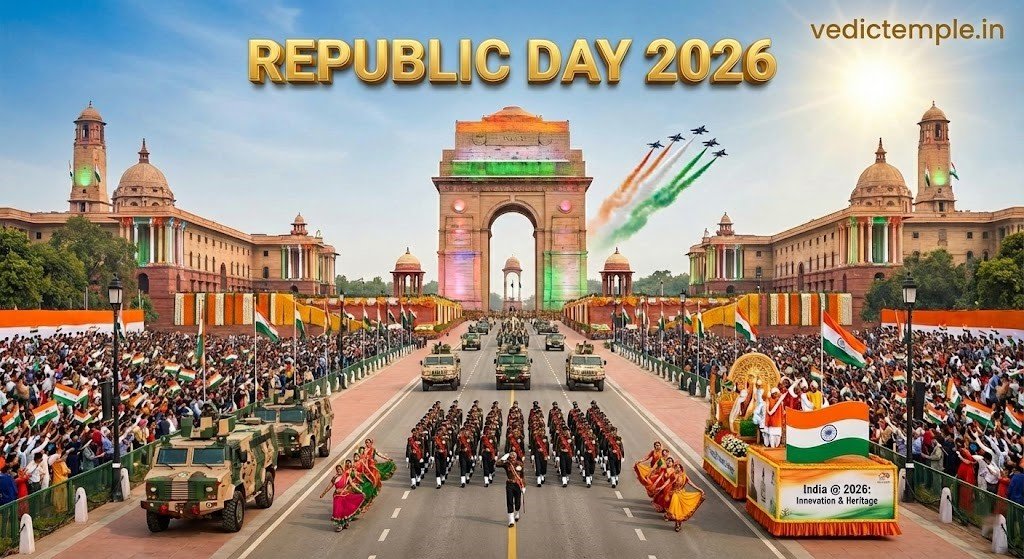
The Real History and Importance of Republic Day.
Every year on January 26th, India awakens to the sound of patriotic songs, the sight of the Tricolor unfurled across homes and offices, and the grand spectacle of the parade at Kartavya Path (formerly Rajpath). But amidst the celebrations, the "Holiday" often overshadows the "History."
As we celebrate another glorious year of our Republic in 2026, it is crucial to pause and ask: Why this specific date? What exactly happened in 1950 that changed the destiny of our nation forever?
Republic Day is not just a date on the calendar; it is the anniversary of India becoming a sovereign entity. This blog takes a deep dive into the history, the struggle, and the immense importance of Republic Day in the fabric of India.
Independence vs. Republic: What’s the Difference?
To understand the history, we must first clear a common confusion. India gained independence from British Rule on August 15, 1947. However, for nearly three years after independence, India did not have a permanent constitution of its own. We were functioning under the modified colonial Government of India Act 1935, and King George VI was still the head of state.
We were free, but we were not yet a "Republic." A Republic is a nation where the supreme power is held by the people and their elected representatives, and which has an elected or nominated president rather than a monarch.
Republic Day marks the transition of India from a British Dominion to a truly Sovereign Democratic Republic.
The History: The Journey to 26th January 1950
The story of Republic Day begins long before 1950. It dates back to the freedom struggle.
1. The Call for Purna Swaraj (1930)
Why was January 26th chosen? It wasn't random. On January 26, 1930, the Indian National Congress proclaimed "Purna Swaraj" (Total Independence) from British rule. It was a bold declaration that energized the freedom movement. For the next 17 years, January 26th was celebrated as "Independence Day" by freedom fighters. When actual independence came on August 15, the leaders wanted to honor the original date of January 26th.
2. The Task of Drafting the Constitution
After Independence in 1947, a Constituent Assembly was formed to draft the supreme law of the land. Dr. B.R. Ambedkar was appointed as the Chairman of the Drafting Committee.
It was a monumental task. The committee had to create a framework that would unite a diverse land of different religions, languages, and cultures into one single nation. It took precisely 2 years, 11 months, and 18 days to finalize the Constitution.
3. The Birth of the Republic
The Constitution was adopted by the Assembly on November 26, 1949 (now celebrated as Constitution Day). However, it officially came into effect on January 26, 1950, to commemorate the 1930 Purna Swaraj declaration.
On this historic day, Dr. Rajendra Prasad began his first term as the President of the Indian Union, and the Constituent Assembly became the Parliament of India.
The Importance: Why Republic Day Matters Today
Republic Day is much more than a nostalgic look at the past; it is a celebration of the rights and privileges we enjoy today.
1. The Supreme Law of the Land
Republic Day celebrates the document that guarantees our fundamental rights. Freedom of speech, equality before the law, and the right to practice any religion—all these are gifts of the Constitution. It ensures that in India, the law is King, and no person is above the law.
2. Unity in Diversity
The Republic Day celebrations, especially the parade, showcase India's military might alongside its cultural richness. It is a powerful reminder that despite our different languages, foods, and traditions, we are bound together by a single identity: Indian.
3. Democracy in Action
This day reminds us that the power of the nation lies in the hands of the common man. It celebrates the democratic process where we, the people, choose our leaders. It is a day to renew our pledge to uphold the democratic values of justice, liberty, equality, and fraternity.
4. A Global Statement
When the Constitution came into force, many critics across the world doubted if a country as diverse and poor as India could survive as a democracy. Celebrating Republic Day year after year is a testament to the world that the Indian experiment is not only surviving but thriving.
Conclusion: The Duty of a Citizen
As we look back at the glorious history of our Republic, we must remember that a nation is not built by governments alone; it is built by its citizens. The Constitution gives us rights, but it also assigns us duties—to respect the national flag, to protect public property, and to promote harmony.
This Republic Day, let us go beyond the forwards and status updates. Let us read the Preamble of our Constitution. Let us understand the struggles of the past to build a better future.
Jai Hind. Jai Bharat.